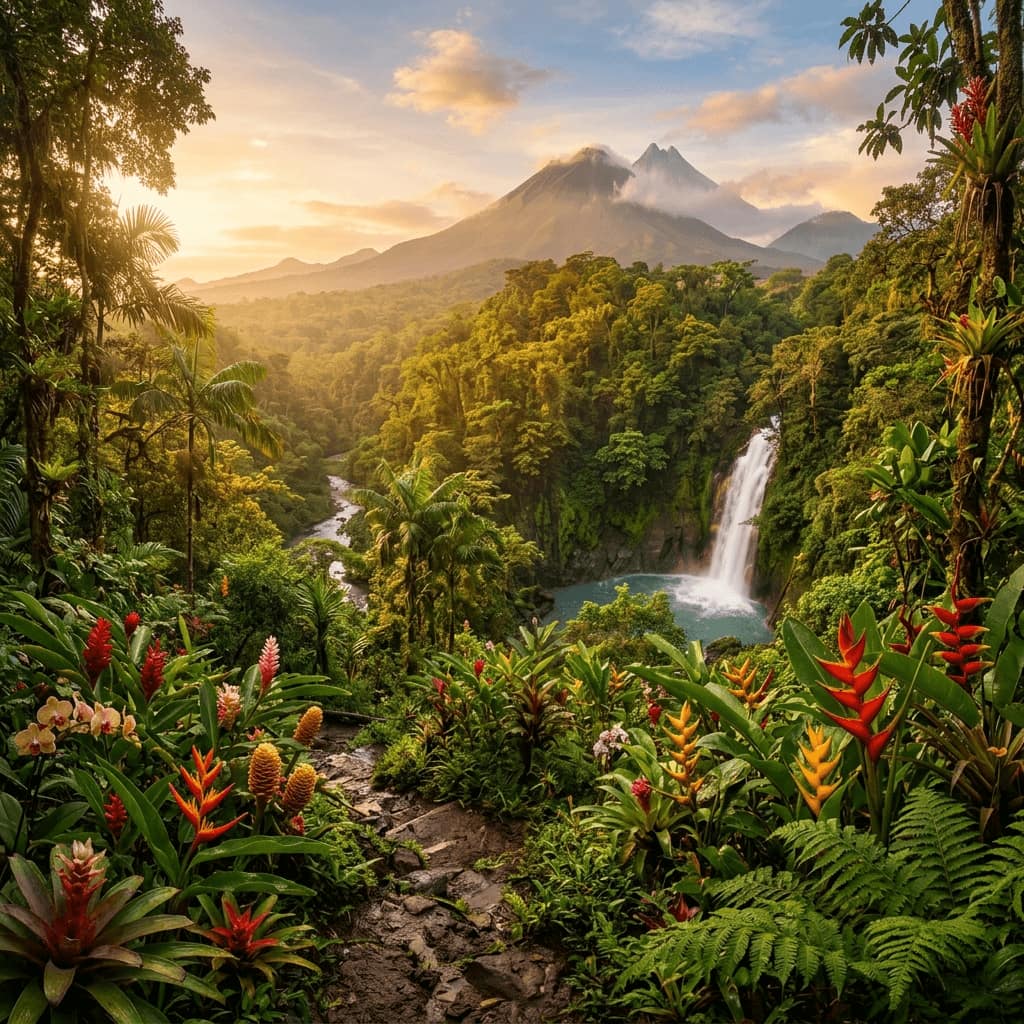
Monteverde Cloud Forest: Our Local Guide
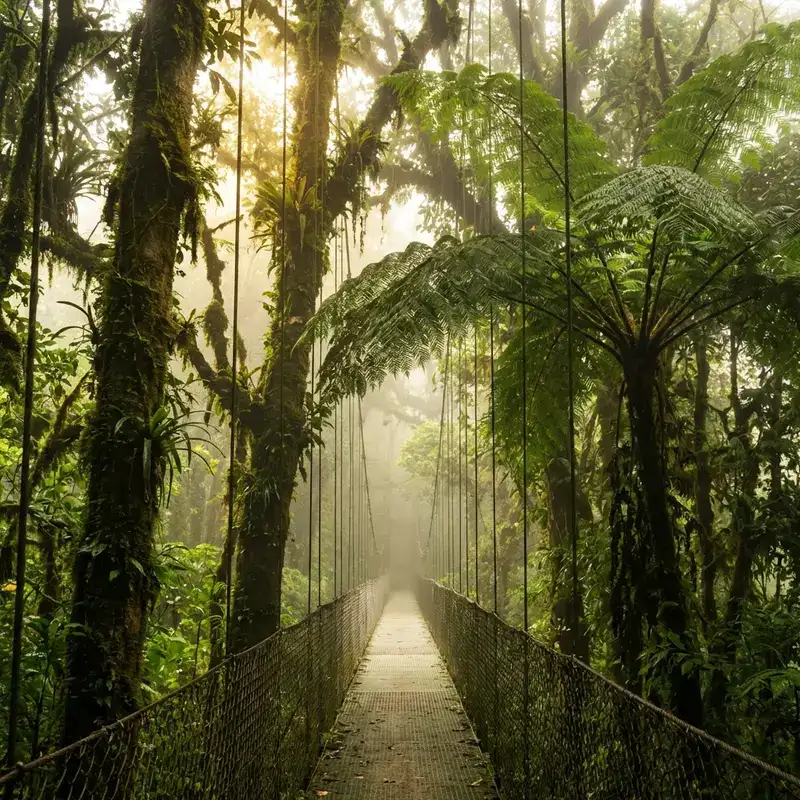
Why Monteverde belongs on your itinerary
Monteverde sits at 1,440 metres on the continental divide, straddling the Pacific and Caribbean slopes. The result is a microclimate unlike anywhere else in Central America: constant mist rolls through the forest canopy, orchids drip from every branch, and the air temperature rarely climbs above 22°C even at the height of dry season. This is the cloud forest that put Costa Rica on the eco-tourism map in the 1970s — and it still delivers.
The reserve system here is exceptional. The Monteverde Cloud Forest Reserve (10,500 hectares) and the adjacent Santa Elena Reserve together protect one of the most biodiverse forest patches in the Americas — over 400 bird species, 100 species of mammals, and more than 2,500 plant species including 500 types of orchid. The resplendent quetzal — arguably the most beautiful bird in the Western Hemisphere — nests here between February and April.
Beyond the wildlife, Monteverde pioneered zip-line canopy tours: what started in the 1990s as a wildlife survey technique became the activity that defined adventure tourism in Costa Rica. Today the region has over a dozen zip-line operators, hanging bridge networks, night walks, and a thriving local community of Quaker farmers whose families have protected this forest since the 1950s. It's a place with a real story — and our guides know how to tell it.
What to do in Monteverde
Cloud Forest Zip-Line
Soar through the misty canopy on cables that stretch up to 1.6 km across the cloud forest valleys. Selvatura and 100% Aventura offer the longest runs; our guided canopy tour uses Selvatura for its cable quality and platform experience. One of the most exhilarating things you can do in Costa Rica.
Hanging Bridges Walk
Walk suspended above the cloud forest canopy on a series of hanging bridges — some stretching 150+ metres — with the tree crowns at eye level. A quieter, more contemplative alternative to zip-lining that rewards birdwatchers and photography enthusiasts. Best in early morning when birds are most active.
Quetzal Birdwatching Walk
A pre-dawn guided walk through the Monteverde Cloud Forest Reserve with a specialist birding guide focused on spotting the resplendent quetzal. February through April is peak season. We also look for the three-wattled bellbird, bare-necked umbrellabird, and orange-bellied trogon.
Monteverde Night Walk
The cloud forest comes alive after dark. A 2-hour guided night walk finds creatures most daytime visitors never see: red-eyed tree frogs, glass frogs, sleeping hummingbirds, fer-de-lance snakes, tarantulas, and the kinkajou. One of our most requested experiences — rarely disappoints.
Santa Elena Reserve Hike
The community-owned Santa Elena Reserve is smaller and less visited than the main Monteverde reserve. Higher in elevation, it often has the densest cloud forest atmosphere — when the mist rolls through in the morning, this is the most otherworldly place in Costa Rica. Beautiful orchid diversity.
Cheese Farm & Coffee Tour
Monteverde's Quaker settlers established the first commercial cheese dairy in Costa Rica in the 1950s — the Monteverde Cheese Factory remains one of the best artisan dairy producers in Central America. Pair it with a visit to a local coffee farm for a morning of real local culture that most package tourists miss.
Getting there
From San José: Approximately 3.5 hours via Sardinal and Las Juntas. The last 30–40 km is unpaved gravel road — passable in a regular car but bumpy in wet season; a 4WD is more comfortable. We offer private 4WD transfers from SJO airport directly to your Monteverde hotel.
From Arenal (jeep-boat-jeep): The most scenic connection in Costa Rica. Taxi or private jeep to the Lake Arenal shore, 1-hour speedboat across the lake to the opposite dock, then 1-hour jeep climb to Monteverde — we run this as a single La Fortuna to Monteverde transfer. About 3 hours total and far more pleasant than the road via Tilarán. We arrange both legs as a single seamless transfer.
Public bus: Two buses daily from San José (Tilawa and Transmontes terminals), taking about 4.5 hours. Affordable but no door-to-door service, and the unpaved section at the end is rough in a large bus.
Best time to visit
Monteverde is worth visiting year-round — the cloud forest is beautiful in every season. December through April is drier (relatively — this is still a cloud forest) and better for quetzal sightings. The green season (May–November) brings extraordinary atmosphere, fewer crowds, and significantly lower prices.
Where to stay
Santa Elena village is the main hub with the most restaurants, tour offices, and budget hotels. A 15-minute walk (or short taxi) from the main reserve entrance. Best for social travelers and those watching their budget.
Along the road to the reserve (between Santa Elena and the Monteverde Cloud Forest Reserve) has most of the mid-range and boutique lodges. Staying here cuts 10–15 minutes off the morning drive to the reserve — valuable when you're aiming for a 6 am quetzal walk.
On the San Luis valley side: A handful of farms and eco-lodges on the Pacific slope below Monteverde offer a quieter, more remote experience and stunning valley views. Best for travelers who want to experience genuine farm life alongside the forest.
Wildlife you'll see
- Resplendent Quetzal — the iridescent green bird with a 60 cm tail; best Feb–Apr at dawn in the reserve
- Three-wattled Bellbird — the loudest bird in the Americas; the male's bonk call carries over 1 km
- Howler and White-faced Capuchin Monkeys — heard (and seen) from dawn in the forest
- Kinkajou — a nocturnal honey-eating mammal spotted on almost every night walk
- Red-eyed Tree Frog — the iconic Costa Rica image; found reliably on night walks
- Glass Frogs — transparent-skinned frogs visible on leaves overhanging streams
- Over 400 bird species — including hummingbirds, trogons, and the emerald toucanet
Insider tips
- Bring a rain jacket and waterproof bag regardless of season — the cloud forest produces its own weather at any time of day.
- Book the Monteverde Cloud Forest Reserve early morning slot (before 9 am) to encounter wildlife before the tour groups arrive.
- The night walk is more reliably good than any daytime walk for sheer variety of sightings — don't skip it.
- Santa Elena Reserve is 20 minutes further from town and sees a fraction of the visitors. It's our preference on busy weekends in high season.
- If you care about the quetzal, come in February or March and stay at least two nights — one morning hike rarely guarantees a sighting.
Monteverde — questions we get every week
How do I get from San José to Monteverde?
What is the best zip-line in Monteverde?
Can I see the Resplendent Quetzal in Monteverde?
What is the difference between Monteverde and Santa Elena Reserve?
Is Monteverde worth visiting in the rainy season?
How do I get from Monteverde to Arenal?
Our tours in Monteverde
- Monteverde Cloud Forest Zip-Line — Full Day, from $225
Other Costa Rica destinations
- Tamarindo — Guanacaste’s surf capital
- Puerto Viejo — Afro-Caribbean Costa Rica
- Uvita & the Costa Ballena — The whale coast
- Río Celeste & Tenorio — The impossibly blue river
- Santa Teresa — End-of-the-road surf town
- Nosara — Wellness meets wilderness